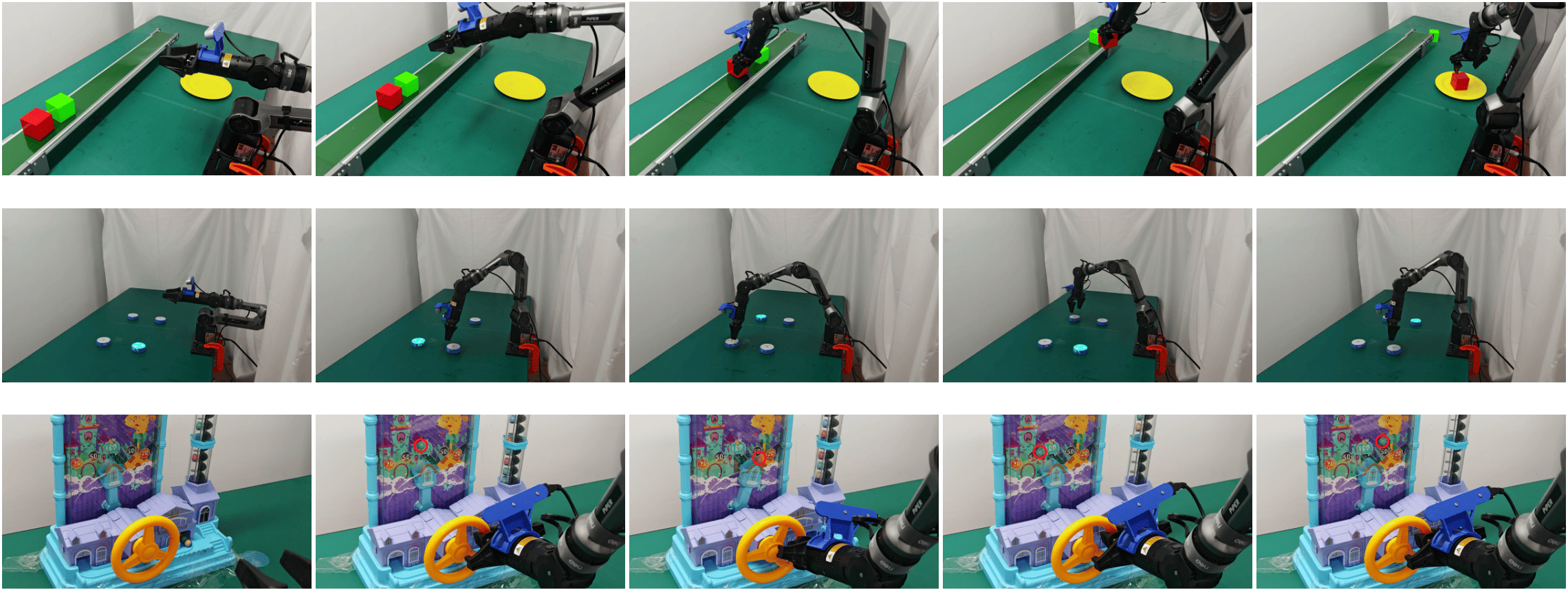
Overview
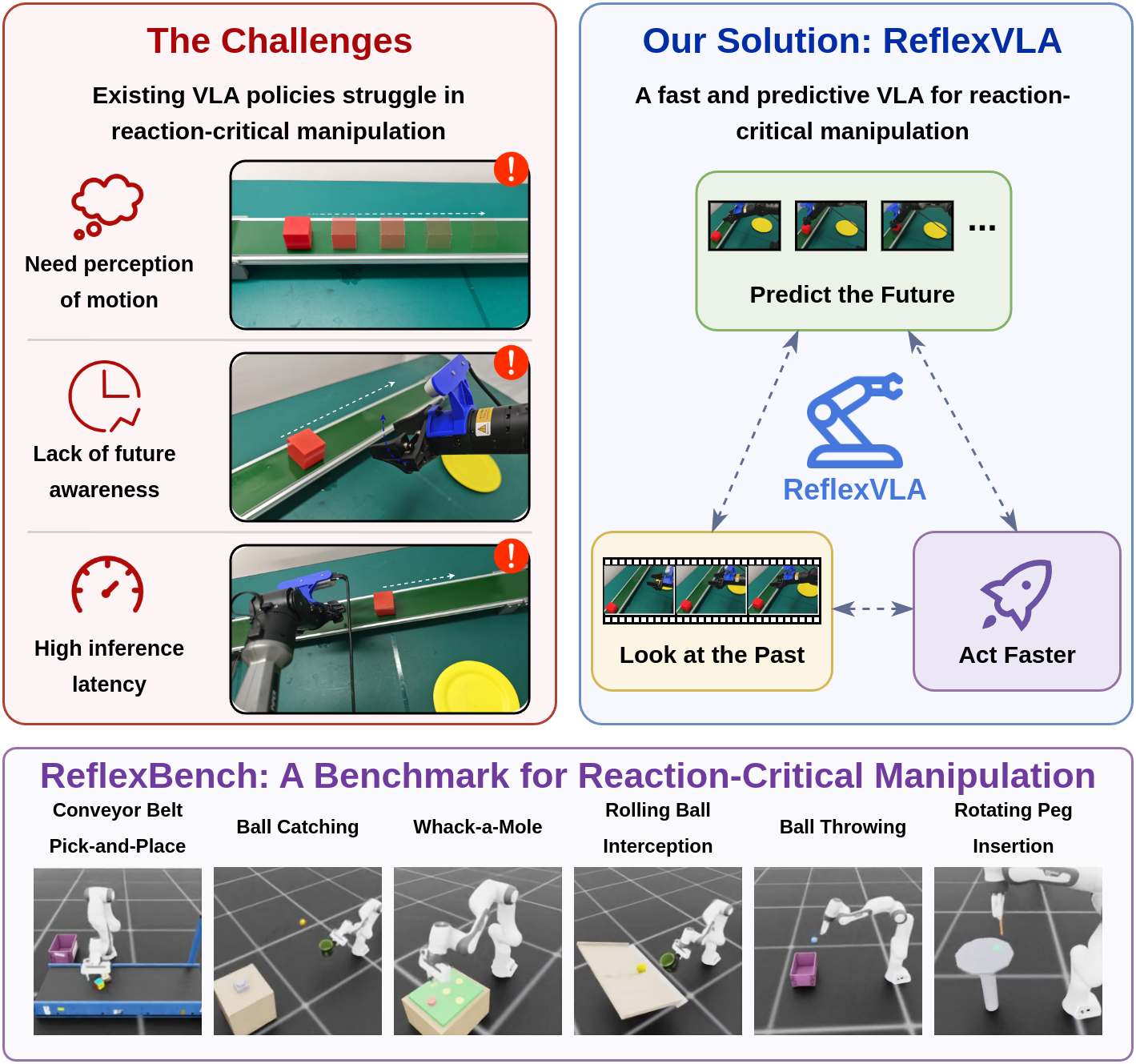
ReflexBench
ReflexBench is a latency-aware benchmark for manipulation tasks in which objects and goals continue to evolve while the policy is computing. It contains six tasks: Conveyor Belt Pick-and-Place, Ball Catching, Whack-a-Mole, Rolling Ball Interception, Ball Throwing, and Rotating Peg Insertion.
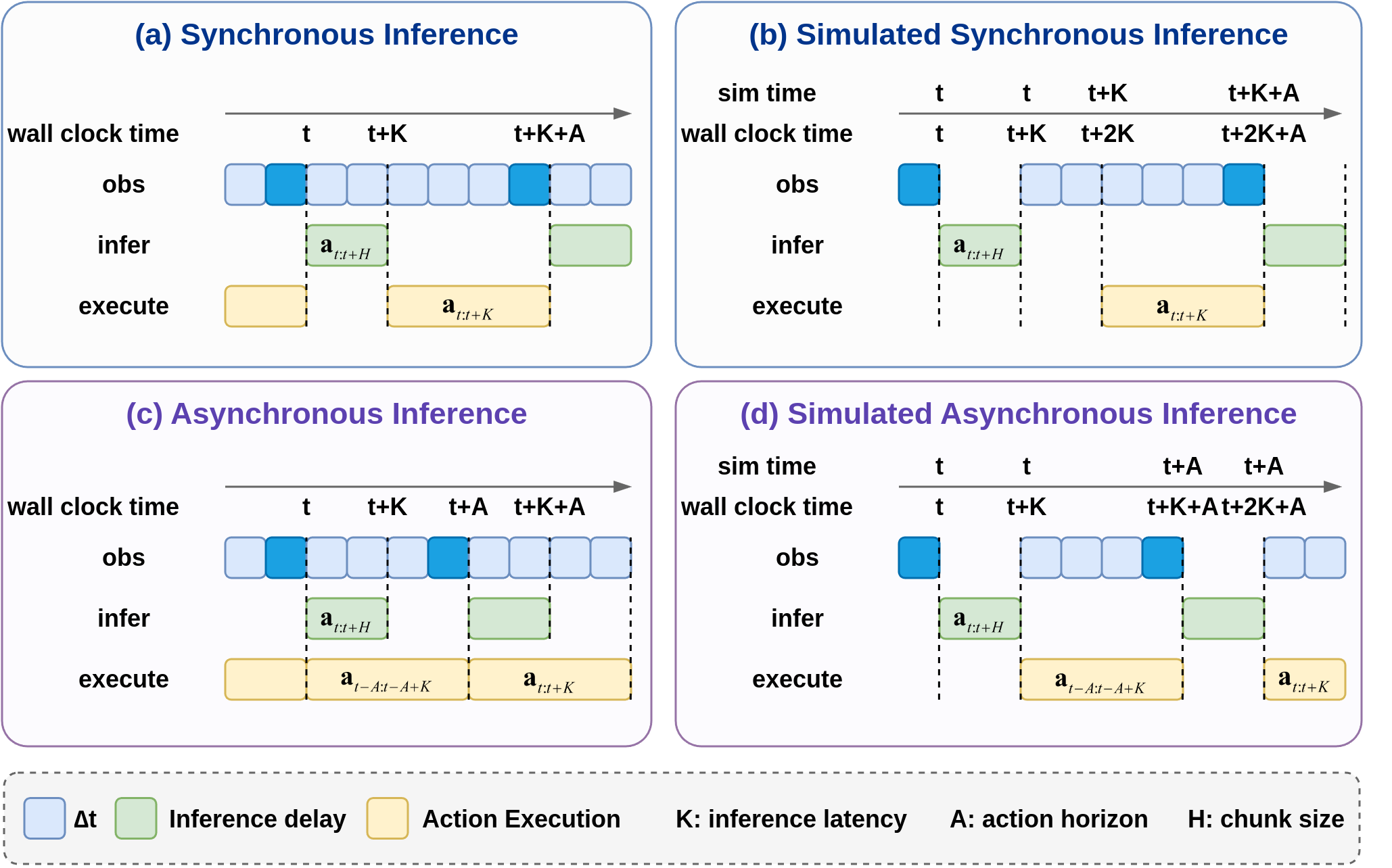
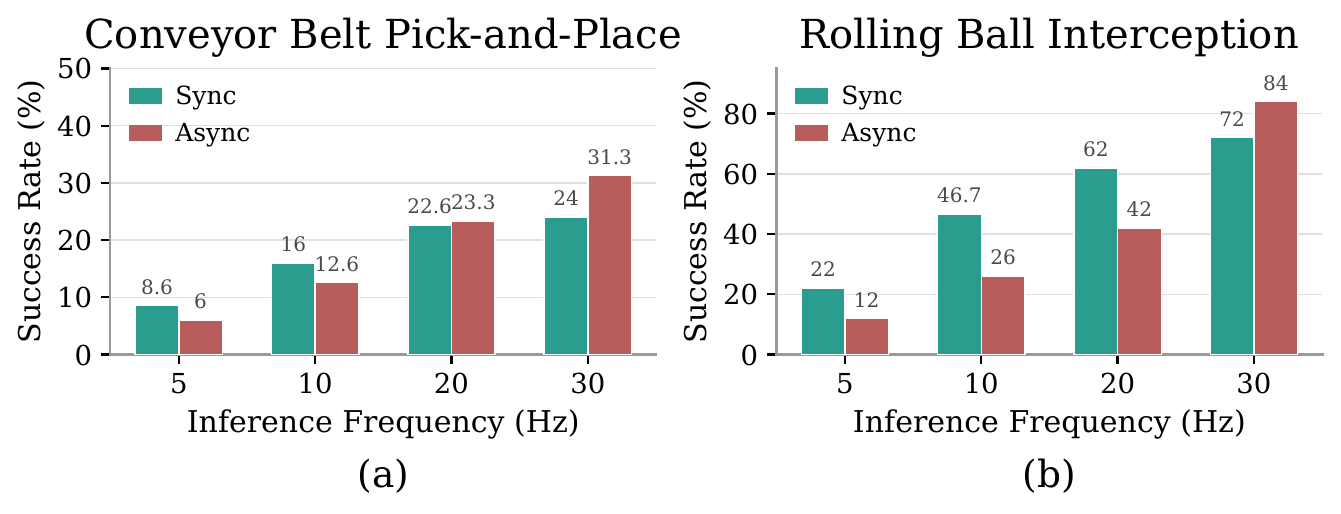
Unlike benchmarks that pause the environment during policy inference, ReflexBench decouples simulation from robot control. It supports both synchronous and asynchronous inference and injects configurable latency, enabling controlled evaluation of perception-execution delay under practical deployment conditions.
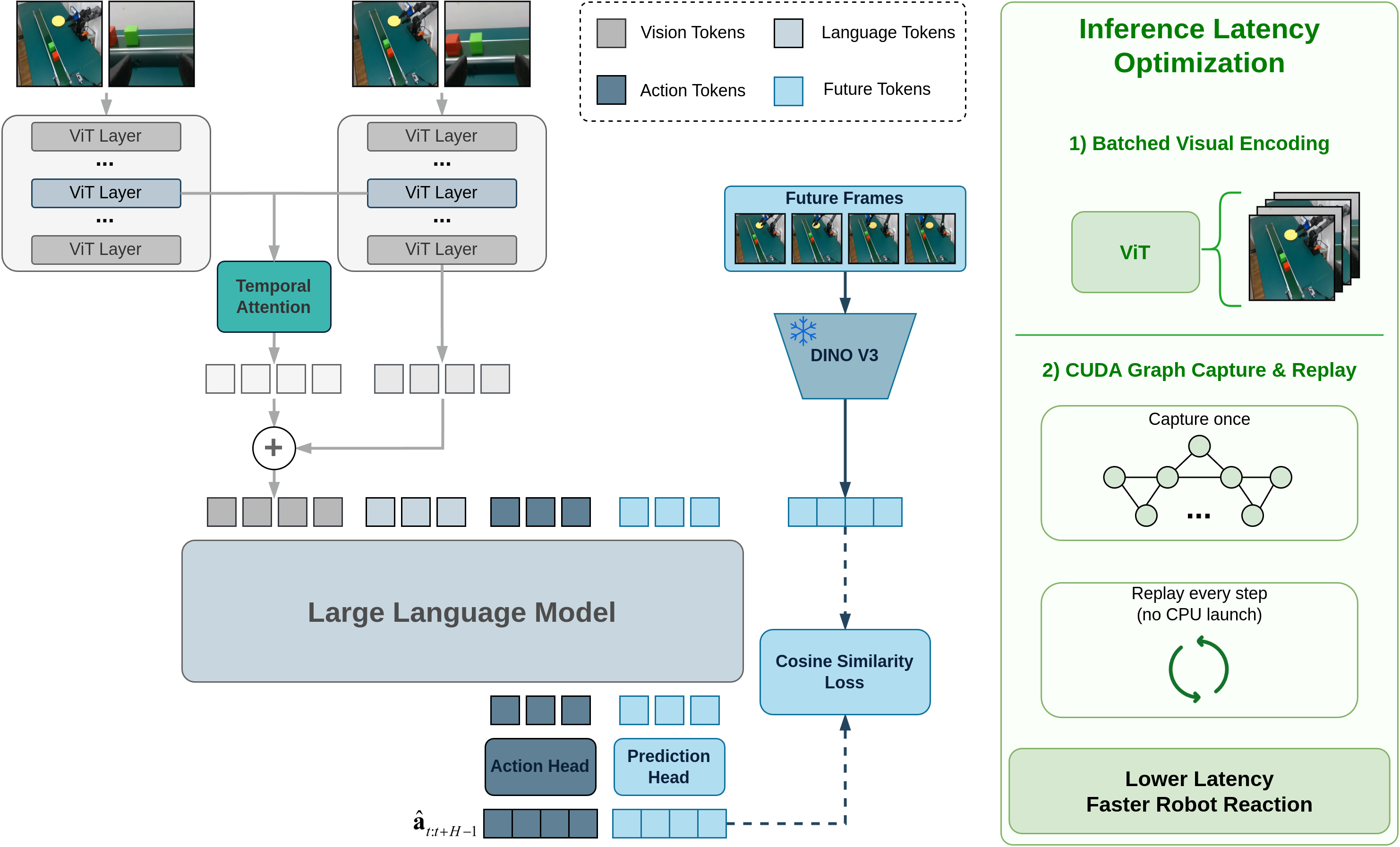
ReflexVLA
ReflexVLA is a compact 1B-parameter VLA designed to react quickly while reasoning about future scene dynamics. It combines three complementary components:
- Latent future prediction learns anticipatory representations by predicting future visual features from a frozen DINOv3 encoder.
- Multi-frame temporal fusion integrates short-term motion cues inside the vision backbone without increasing the number of visual tokens consumed by the language model.
- Inference latency optimization uses batched visual encoding and CUDA Graph replay to reduce deployment overhead.
Experiments
Latency-Aware Inference
Main Results on ReflexBench
Performance comparison on ReflexBench. Results are mean success rate (%) ± standard deviation over three runs.
| Model | Params | Conveyor Belt Pick-and-Place |
Ball Catching |
Whack-a- Mole |
Rolling Ball Interception |
Ball Throwing |
Rotating Peg Insertion |
Avg. |
|---|---|---|---|---|---|---|---|---|
| OpenVLA-OFT | 7B | 58.0 ± 1.2 | 5.3 ± 1.2 | 100.0 ± 0.0 | 41.4 ± 4.2 | 10.0 ± 3.3 | 1.3 ± 0.7 | 36.0 |
| π0.5 | 4B | 39.1 ± 1.0 | 6.0 ± 0.7 | 98.9 ± 0.3 | 36.8 ± 1.8 | 34.0 ± 2.7 | 6.7 ± 1.4 | 36.9 |
| PUMA | 4B | 67.4 ± 1.7 | 4.0 ± 0.7 | 100.0 ± 0.0 | 85.1 ± 3.4 | 33.8 ± 1.0 | 11.1 ± 1.7 | 50.2 |
| DynamicVLA | 0.5B | 30.6 ± 2.4 | 4.4 ± 1.0 | 90.2 ± 1.7 | 45.8 ± 1.7 | 36.2 ± 4.7 | 16.7 ± 4.2 | 37.3 |
| SmolVLA | 0.5B | 19.3 ± 2.0 | 2.9 ± 0.8 | 100.0 ± 0.0 | 70.2 ± 2.0 | 27.1 ± 1.0 | 10.0 ± 4.6 | 38.3 |
| VLA-Adapter (Baseline) | 1B | 36.8 ± 2.4 | 6.0 ± 2.0 | 68.4 ± 3.9 | 23.1 ± 7.7 | 29.1 ± 5.2 | 18.4 ± 2.5 | 30.3 |
| ReflexVLA (Ours) | 1B | 73.8 ± 4.1 | 7.3 ± 0.7 | 100.0 ± 0.0 | 77.1 ± 7.1 | 31.7 ± 1.0 | 12.4 ± 1.5 | 50.4 |
ReflexVLA achieves the highest average success rate on ReflexBench. It improves the VLA-Adapter backbone from 30.3% to 50.4%, outperforms substantially larger general-purpose VLAs, and matches PUMA while using only one quarter of its parameters.
Results on LIBERO
Success rate (%) on the standard static manipulation benchmark.
| Model | Spatial | Object | Goal | Long | Avg. |
|---|---|---|---|---|---|
| OpenVLA-OFT | 97.6 | 98.4 | 97.9 | 94.5 | 97.1 |
| π0.5 | 98.8 | 98.2 | 98.0 | 92.4 | 96.9 |
| VLA-Adapter | 97.8 | 99.2 | 97.2 | 95.0 | 97.3 |
| ReflexVLA (Ours) | 98.2 | 99.2 | 98.0 | 93.6 | 97.2 |
Although ReflexVLA is designed for dynamic manipulation, it maintains a 97.2% average success rate on LIBERO, comparable to the best-performing VLAs.
Ablation Study
Progressive ablation of ReflexVLA. SR denotes success rate and Lat. denotes inference latency.
| Method | Variant | SR (%) | Lat. (ms) |
|---|---|---|---|
| Baseline | — | 36.8 | 81.522 |
| + Future Pred. | Trainable | 4.9 (−31.9) | 82.508 |
| Frozen | 62.8 (+26.0) | 82.508 | |
| + Temporal Fusion | Cross Attn. | 66.1 (+29.3) | 127.335 |
| MHA | 68.2 (+31.4) | 125.824 | |
| MHA (Middle) | 71.7 (+34.9) | 125.107 | |
| + Latency Opt. | Batch Enc. + CUDA Graph | 73.8 (+37.0) | 64.991 |
Frozen latent targets provide stable predictive supervision, temporal fusion at intermediate visual features best captures motion, and batched encoding with CUDA Graph replay reduces latency from 125.1 ms to 65.0 ms while further improving success.
Real-World Experiments
Results over 20 evaluations per task. Conveyor reports successful trials out of 20; PressButtons reports buttons pressed within 30 seconds; CatchBalls reports balls caught out of 10.
| Model | Conveyor | PressButtons | CatchBalls |
|---|---|---|---|
| SmolVLA | 2/20 | 0.9 | 3.8 |
| PUMA | 13/20 | 20.8 | 5.4 |
| ReflexVLA (Ours) | 16/20 | 22.5 | 6.7 |